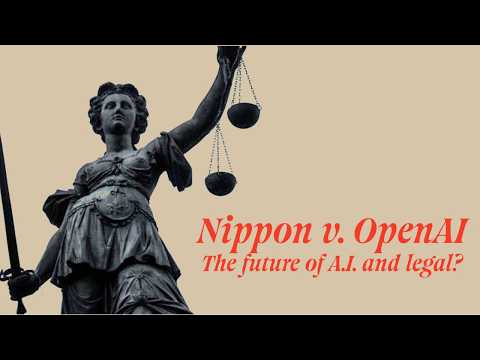
Recently, Nippon Life sued OpenAI because one of OpenAI’s users had used ChatGPT to re-open a case that had been settled.
The consequence of the same was that the person filed 44 motions after firing their lawyer. And in this case, Nippon is suing that ChatGPT acted as a lawyer, which is in breach of the licensing requirements of practising law. And also, the fact that this case had been settled.
Nippon is seeking $300,000 in damages from OpenAI. And a further $10M in punitive damages.
This will be an interesting case to watch as it plays out as it might define a lot of how we interact with AI in the legal space.
Growing companies have tons of problems to solve. So they hire a lot as they grow. At some point, these problems go away. What you get are employees who are probably doing little. And also most likely executives who delude themselves that the problems they oversaw have reincarnated into bigger ones.
The funny thing about this is that we see this play out in teams and roles.
An exec flex is how big the teams they manage are. I mean, if the stick is that the number of big problems you’re in charge of are the number of people, then guess what? You want more people underneath your box in the org chart.
This could partially explain why some organizations have titles that hardly describe the job to be done. But prefixes - such as - Sr. / Associate / Head - that organize the troops and dangle dropping or adding them as a part of promotion.
Join these two things and it’s the bureacracy-olympics where you compete in hiring budget wars and the hardware is more people! But the thing you are building is an inability to execute.
Jack Dorsey - the brilliant product CEO behind Twitter, Square, and CashApp - recently announced on X / Twitter that he was cutting 40% of Block’s headcount. From 10,000 to 4,000. The announcement set off a series of people talking about AI replacing all sorts of jobs ( as was mentioned by Jack ). But also missed the point that ramping up employees 3X during Covid was a necessity. And in line with the observable dynamic that we talk about.
Now the part that everyone is talking about is the part where Jack mentions the use of intelligence tools ( good spin on not saying AI ). But people have been dwelling on this and missing the situation at play.
but something has changed. we’re already seeing that the intelligence tools we’re creating and using, paired with smaller and flatter teams, are enabling a new way of working which fundamentally changes what it means to build and run a company. and that’s accelerating rapidly.
Recall how we end up playing bureacracy-olympics, and then you start to see that the sentence in bold above can be inverted to call out bloated companies as being capable of truly using AI / machine intelligence.
The inverted version would say “flatter teams, paired with [proprietary] intelligence tools, are enabling a new way of working”.
What this reminds me of is why about 70% of digital transformations fail. The reason for these occupations have been as much about warring political power within organizations than real outcomes.
But more importantly it is instructive that the inverted sentence is the place you want to start from. Because if you decide to cut 40% of your company — who are you going to cut? Who makes these decisions? Who stays if not the most political animals within us?
The main problem is that even modest differences in abilities, when powered with amplifiers such as intelligence technology, will produce massive differences in outcomes.
So it’s not even AI that’s really eating your lunch. But better composed teams working for or with organizationally innovative companies.
Earlier this year, we pitched a few hedge funds. If billions in real estate assets they manage are exposed to big, hairy, scary climate and environmental risks — why not bankroll the incubation of a company that’d scream bloody murder the moment things seem to face getting roasted, soaked, or haunted by Mother Nature?
During advanced talks, the final pushback was academic: Markets were efficient and everyone would use this information exactly once. I didn’t buy it. Mother Nature ping-pongs, and not exactly once.
The risk for the entity was actually simpler: data.
I naively bet the deep pockets would help buy the data. But this would be doing what insurance does – where they buy from a duopoly of data providers. The results have pretty much been a disaster as and has said insurance companies have had to flee certain markets.
Enter Zillow
The New York Times recently wrote about a different wrath - Zillow Removes Climate Risk Scores From Home Listings. Real estate sellers are mad that Zillow is giving their houses a flood score that will make it impossible to sell or get the real value of their house.
“It’s like they’re trying to drive down property values,” said one seller in Florida, who asked to be identified only as “a very concerned homeowner.”
I see this point. These are models and their methodology could point out to a house inaccurately or using probabilities – which most of us human beings just do not do well with as the numbers tend to sound absolute versus chance-ful.
But should we abolish Rotten Tomatoes for movies? Ignore the little health inspections for restaurants? Or happily match into a dentist with a 1 out of 5 rating?
No. There is an inevitability to what is happening. The company involved has a clear understanding & transparency of the methodology that they use, but then lacks specificity because they have no longitudinal data on which houses actually flooded, when and where.
This sounds eerily familiar.
It’s all about the data, the right kind
When your house floods, there are those calls you make to the local folks who can help you. The inquiry logs, quotes, and eventual inspection are all records that most likely end up in cabinets or in the shredder. They are recorded as sales by the service provider. And a memory best left distant by the home owner.
But they hold a treasure trove of important core signals of geographical areas where flooding could be happening or likely to happen. It is thus in these “boring” businesses that the most accurate and reliable data lives. And the innovation is on how to make these businesses keep doing their work while actually powering physical intelligence.
Funny enough, you can link Atari games to AI job losses. Less funny is the stark omission of the probable decimation of “AdTech”.
Al (spelling: A-L) Gore — inductee to the Internet Hall of Fame and of Veep and nearly prez fame — was part of the 1980s “Atari Democrats”. He’s a prominent part of the long arc of advertising riches, which traces a path From: Atari’s Pong as exemplar of America’s technological dominance. To: setting the rules of the road for the modern internet.
Clinton/Gore saw private companies gain unfettered latitude to surveil users, in service of providing better services and products.
No righteousness here.
But the agreed monetization was / is advertising. Membership models have always been on the table. That’s why subscription models exist as the immediate alternate. Binge watch with no ads!
This has created the new ouroboros – an advertising serpent eating its own tail to rebirth. You could go back to the Bible/print press dynamic, but … we are in 2025. More recently, you can take the classifieds and newspapers dynamic. The serpent ate!
Cookies have been the center of monetizing the internet. They are like a button on a shirt, assuming being attached to the fabric that makes the shirt makes them part of the fabric. Not. They get lost. Replaced. And no one really says – “nice buttons”. That’s how you buy a fridge and get more fridges in your ads
Browser wars are always brutal. And the oncoming proliferation — Strawberry, OpenAI Atlas, The Browser Company’s Dia, Perplexity Comet is no different. What is really happening is that no one wants cookies anymore. They want the whole jar. They want to the be the fabric. Not the buttons.
It is the most tangible reality of AI we are seeing playing out. The “surveillance” needs to all happen in one place for the returns to be acceptable. And frankly, the ads better.
It is beyond cookie cutting now.
EY and PwC Partners are creating a new rival to their old churches - one that is “AI-led rather than based on legacy infrastructure”. It’s kinda disruptive, but not zero-sum.
Several companies make super talented people compete for single spots at the top. A bunch of the former Big Four crew finding their groove back on this venture were passed over on being Head Priest. It’s not that they’re not good. And that’s the point.
The very rich part of legacy companies is that their business models work. But as technologies extend capabilities, they face the existential threat of being sandboxes.
What does this mean? The density of talent (that they pass over) has this chance to create valuable companies that look similar on the outside, but vastly different inside.
Risk averse careerists possess the institutional advantages of incumbents. If they deploy intelligence technologies, then they get to redesign legacy businesses while managing risks in ways only they who know the weeds can.
They take the worst of yore - like bloat and politics - and work them into irrelevance. And embrace the best - like distribution or low capital costs - and replicate them super effeciently ( and fast, sans bureacracy ).